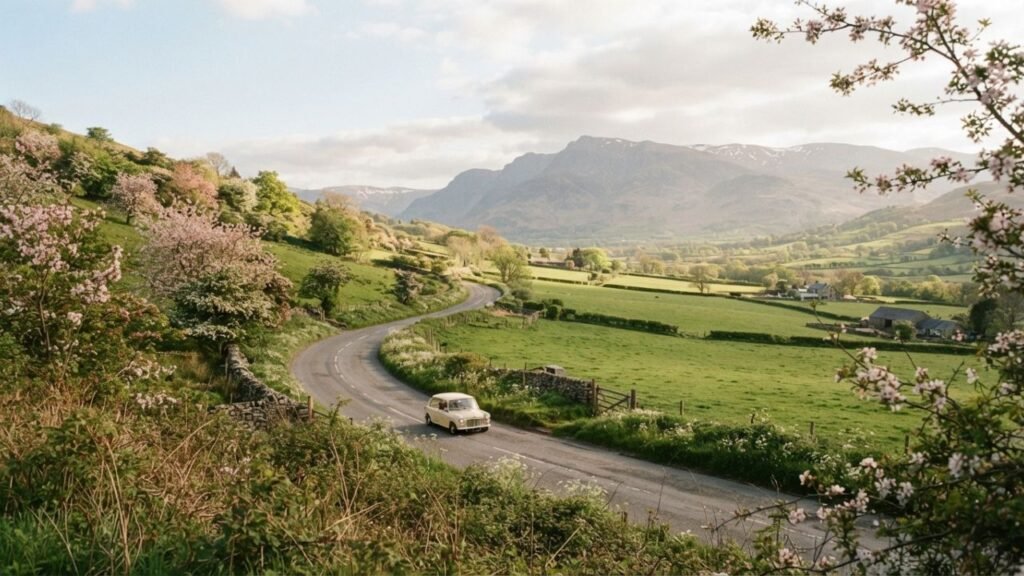
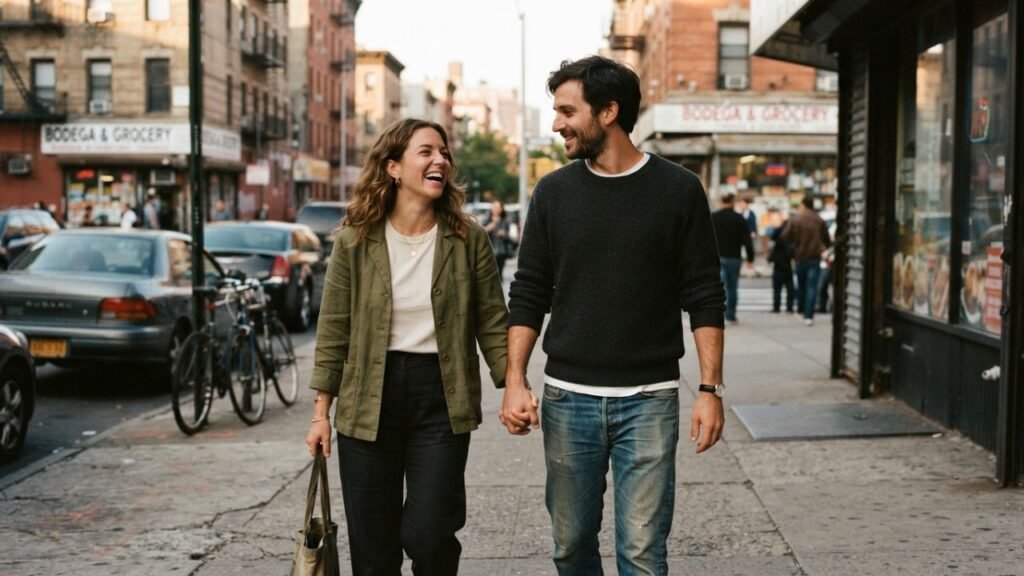
The best engagement sessions aren’t miniature weddings. They’re a chance to photograph a relationship before the ceremony, styling and expectations take over the frame.
An engagement photograph is usually expected to do something quite simple: show two people in love, looking good, somewhere attractive.
That is why so many of them begin to look alike.
The familiar ingredients are easy to recognize. A sunset. A ring held toward the camera. Coordinated clothes. A walk through a field. A kiss against some agreeable architecture. None of these is a problem in itself. The problem is that they can turn the engagement session into a miniature version of the wedding: carefully arranged, visually polished and slightly detached from the lives of the people being photographed.
There is another way to think about it.
An engagement session happens during an unusually interesting period in a couple’s life. They are committed, but the ceremony has not happened. They are planning a public event, while still living an ordinary private life. They have a ring, but perhaps no wedding clothes. They may have chosen a photographer they barely know.
That makes the session less a rehearsal than a kind of photographic interval.
It gives the camera access to the relationship before it becomes an occasion.
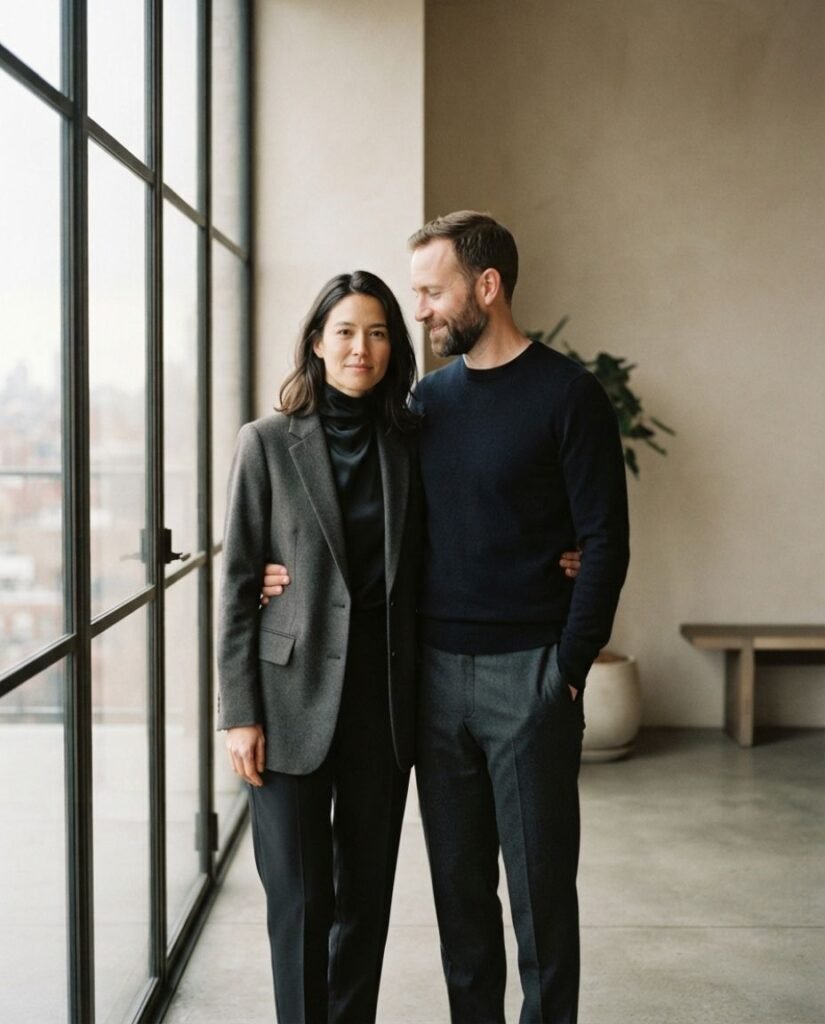
The engagement portrait sits between announcement and intimacy
Photography has long been used to make relationships visible.
Early wedding and marriage photographs were often formal because photography itself demanded a degree of formality. Nineteenth-century wedding portraits, for example, frequently show couples posed stiffly and deliberately, reflecting both the limitations of the technology and the social function of the photograph.
The engagement portrait inherited some of that function: it announces a change in social status.
But the contemporary engagement photograph has another job. It is expected to look intimate, spontaneous and personal.
That creates an interesting contradiction.
The photograph is carefully produced, yet it is supposed to look as though nobody produced it.
The photographer directs the couple, chooses the location, considers the light, selects lenses and controls composition. The couple chooses clothes and arrives knowing they are going to be photographed. Yet the final image is often judged by how little of that machinery is visible.
Even royal engagement portraits have played with this distinction. When Prince Harry and Meghan Markle announced their engagement in 2017, the official images deliberately offered contrasting modes: one formal and composed, another noticeably more intimate. Vogue described the formal/informal pairing as part of a tradition associated with earlier royal engagement portraits.
The distinction remains useful for everyone else.
A good engagement gallery does not have to choose between a beautiful portrait and a believable one.
It can make room for both.
“Be natural” is not actually useful direction
Most people are not comfortable being photographed.
The moment a camera appears, ordinary body language becomes strangely complicated. What do you do with your hands? Where do you look? Should you smile? How close should you stand?
Telling someone to “just be natural” rarely solves this.
Portrait photographers know that people often need some form of direction. Canon’s portrait guidance recommends conversation and rapport to help subjects relax, while its engagement photography guidance suggests using the opening part of a session as a warm-up before moving into more deliberate photographs.
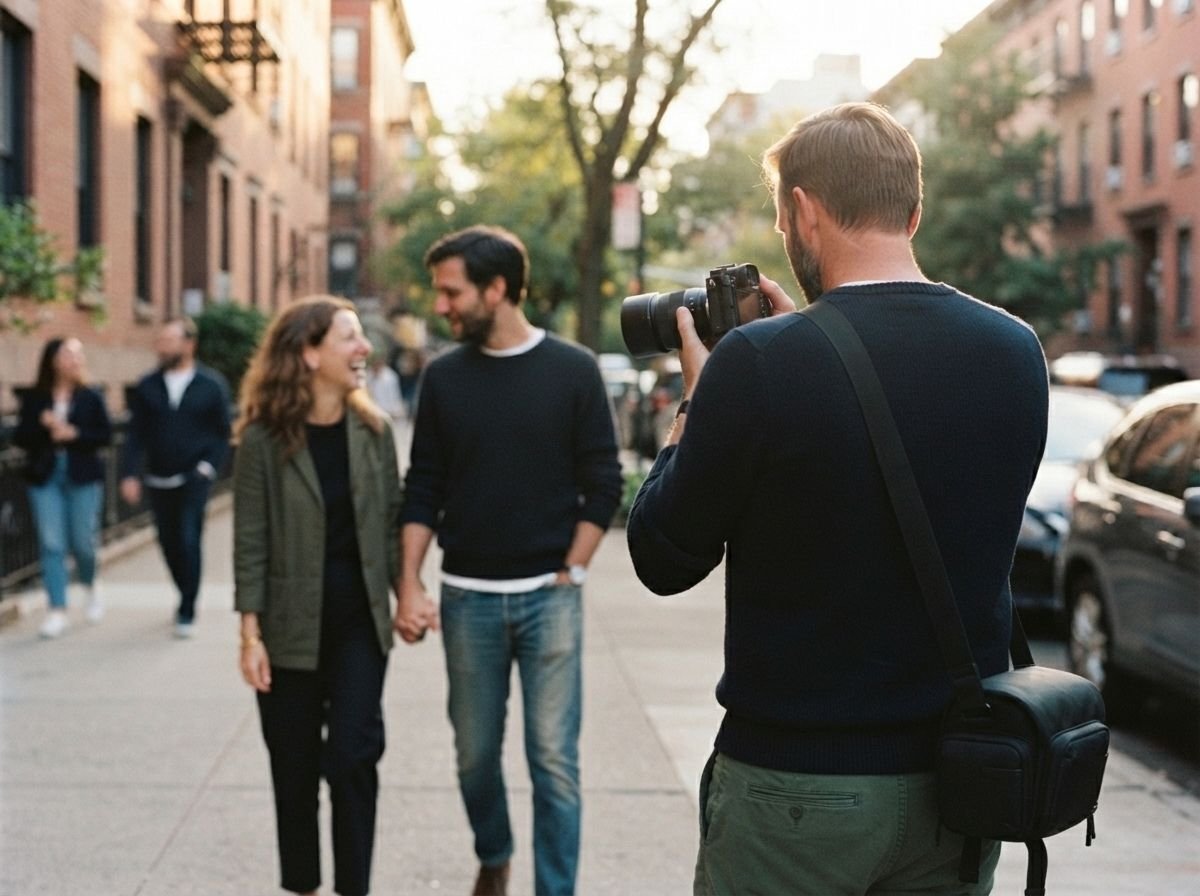
The more interesting approach is to give people something to do rather than something to perform.
Walk somewhere.
Tell the story of your first date.
Make coffee.
Fix your partner’s collar.
Look through a shop window.
Sit on the floor.
Argue playfully about where to have dinner.
The activity does not have to appear in the final photograph. Its purpose is to give the body somewhere to go and the mind something to occupy itself with.
That is when small, revealing gestures begin to happen.
One person reaches for the other’s hand without being told. Someone laughs before the photographer is ready. A jacket gets adjusted. A glance lasts half a second longer than a posed smile.
These details are not necessarily dramatic.
They are useful because they are difficult to fake.
The best location may be somewhere nobody would put on a mood board
A beautiful location can produce a beautiful photograph.
But beauty and relevance are not the same thing.
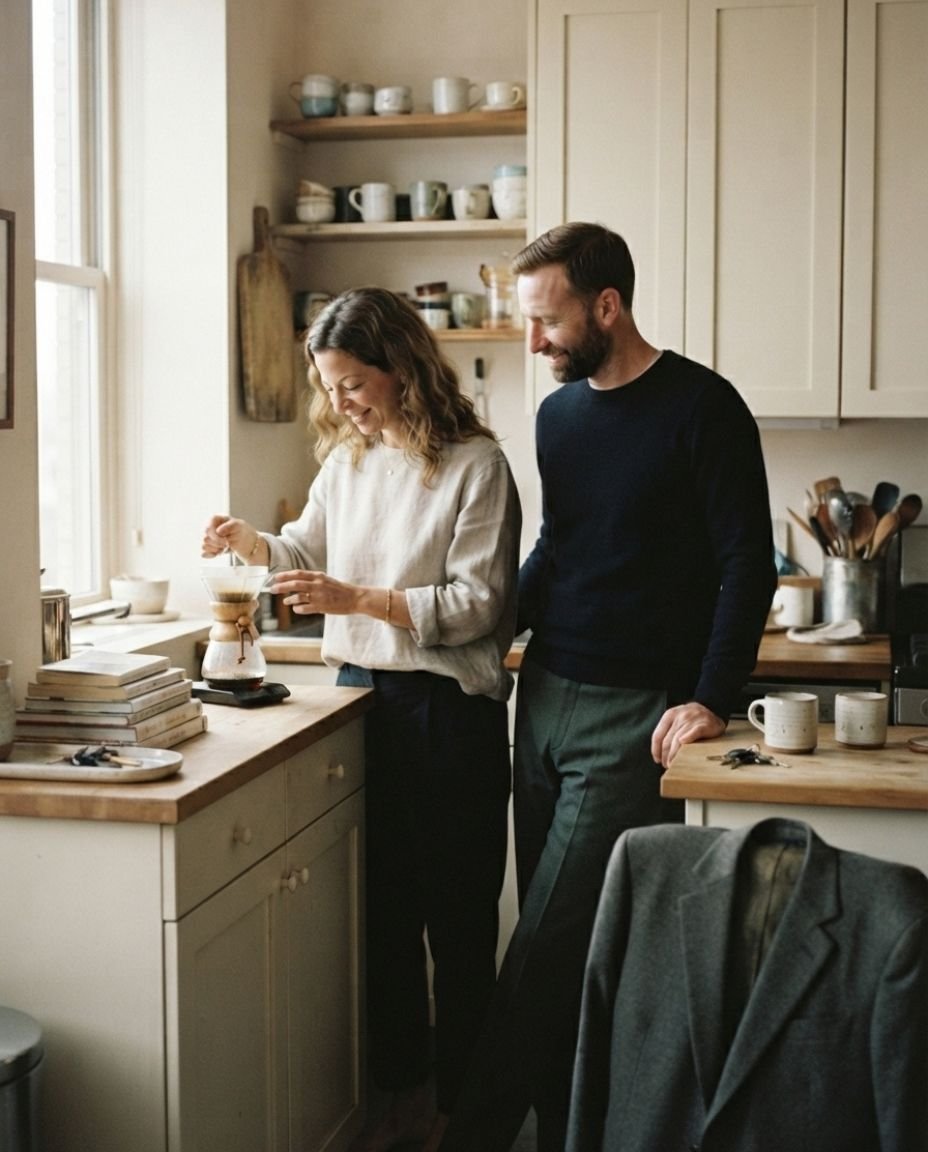
Canon’s engagement-photography guidance recommends choosing locations with personal significance and notes that couples increasingly use real-world settings, including their own homes, rather than relying exclusively on studios or conventionally romantic scenery. It also recommends scouting locations at the actual shooting time to understand light, foot traffic and accessibility.
That practical advice points toward a larger idea.
Instead of asking:
Where will we look romantic?
Ask:
Where do we behave like ourselves?
Perhaps it is the restaurant where you always order the same dish. The street between your apartments. A family home. A record shop. The park where you walk after work. A train station. The kitchen where one of you cooks and the other gets in the way.
The place does not need to be picturesque.
It needs to give the photograph something to observe.
A location becomes valuable when it changes behaviour, supplies context or creates a visual relationship between the people and their surroundings.
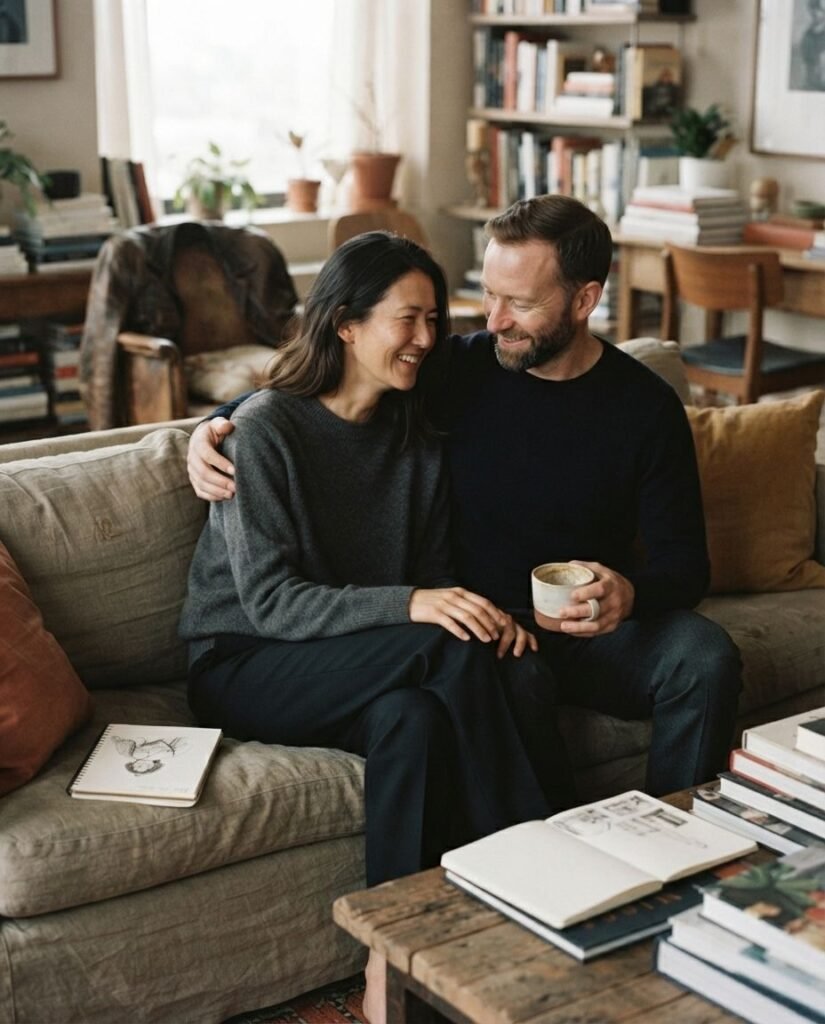
A couple sitting on their own sofa tells us something different from the same couple sitting on a rented vintage chair in a styled studio.
Neither is more authentic by definition.
But they are different stories.
Light should establish the mood, not dictate the cliché
Golden hour has become almost synonymous with engagement photography because it is forgiving. Low evening light can produce softer illumination and attractive backlighting, while overcast conditions can provide relatively even, diffused light. Canon specifically notes the usefulness of golden-hour light and overcast conditions for portraits.
But “best light” is not the same thing as “most romantic light.”
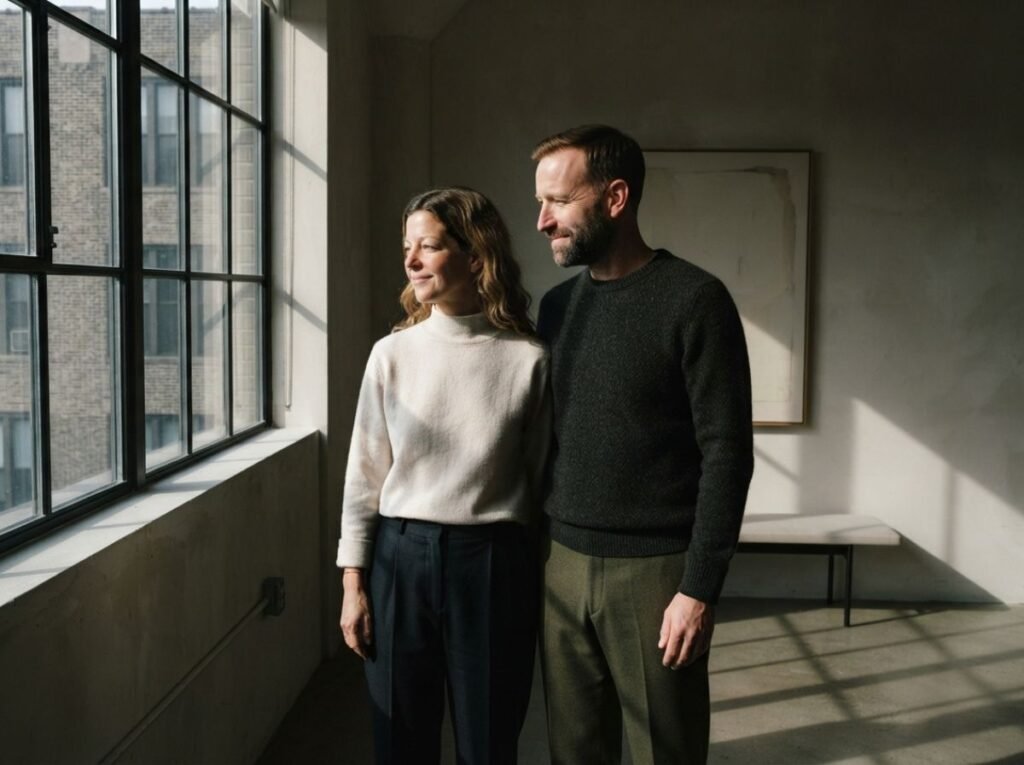
Hard afternoon sunlight can create graphic shadows. A doorway can divide a face between brightness and shade. Window light can make a domestic scene feel quiet and intimate. Nighttime street lighting can introduce colour and reflections that would never appear in a conventional sunset portrait.
The technical choice changes the emotional reading.
Soft light tends to smooth surfaces and reduce visual distraction. Harder light can reveal texture and create stronger geometry. Backlight can turn hair, fabric and edges into luminous shapes. Artificial light can make an ordinary street feel unfamiliar.
The question should therefore be less about chasing a particular hour and more about deciding what kind of photograph you want.
Do you want the light to flatter the couple, describe the place, or become part of the picture itself?
Sometimes it can do all three.
The ring is important. It doesn’t need to dominate
The engagement ring is an obvious photographic symbol, which is precisely why it is easy to overuse.
A close-up of the ring has a clear documentary purpose. It records an object that has entered the couple’s life at a particular moment.
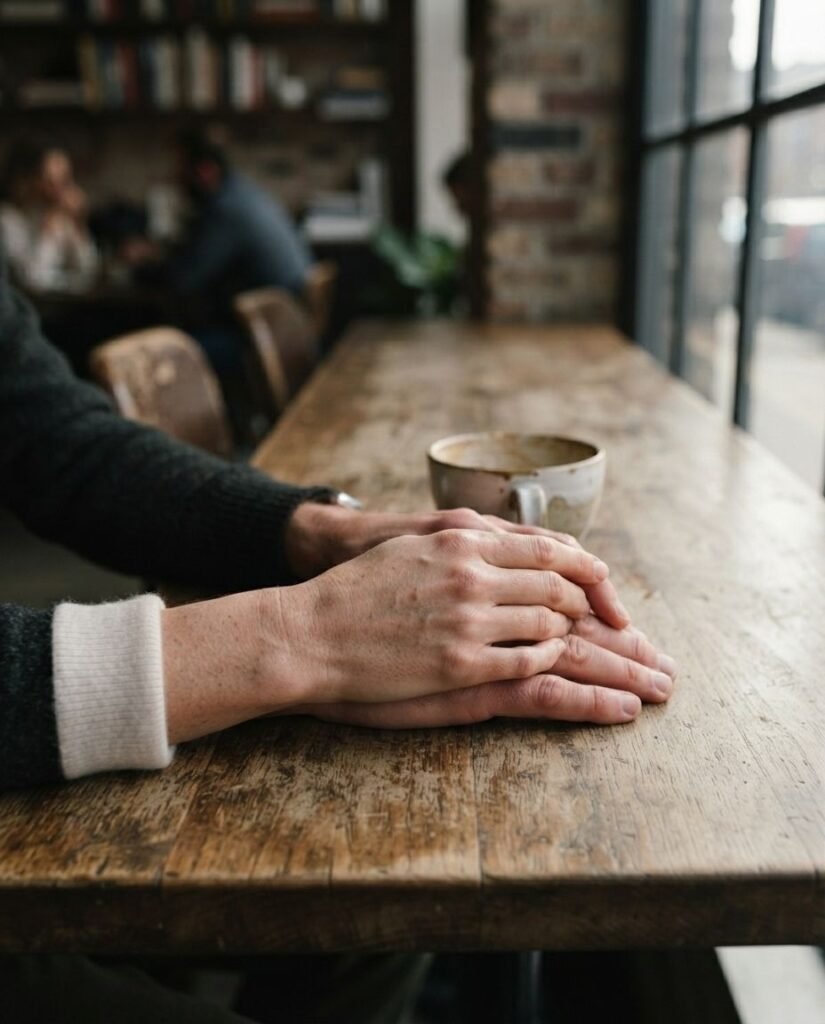
But the more interesting photographs may allow the ring to remain incidental.
A hand resting on a table.
Two people holding hands while crossing a road.
A sleeve being pulled over a wrist.
A hand placed on someone’s shoulder.
The ring is there, but it is part of the relationship rather than a substitute for it.
This is a useful principle for engagement photography generally: symbols become more convincing when they are allowed to live inside ordinary behaviour.
The same applies to flowers, champagne, handwritten signs, cars, books or other props. If an object has a genuine connection to the couple, it can deepen the photograph. If it is there only because engagement photographs are supposed to contain it, the image can start feeling like a catalogue.
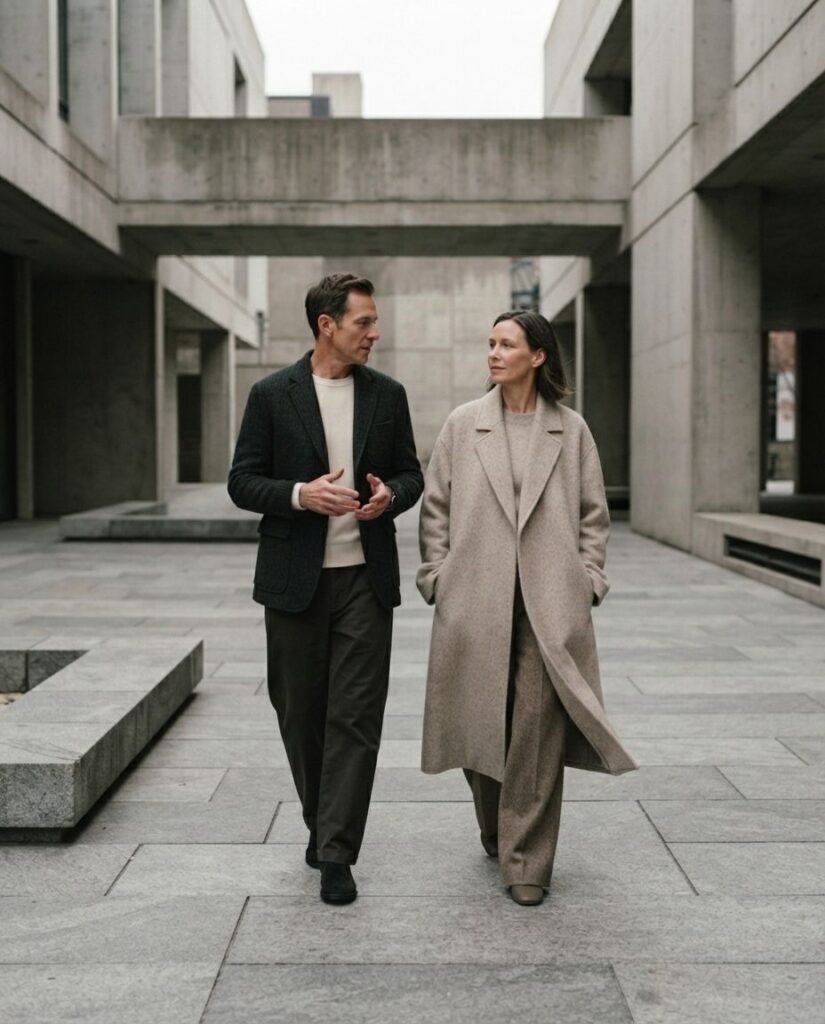
Clothing is part of the composition
What a couple wears affects much more than colour.
It changes movement, silhouette, proportion and the relationship between the two bodies.
A structured jacket creates a different shape from a loose knit. A long skirt moves differently from tailored trousers. A monochromatic outfit can allow architecture to become more prominent, while contrasting colours can separate two figures clearly within a busy environment.
This is why “wear something you feel comfortable in” is incomplete advice.
Comfort matters, but so does photographic behaviour.
Can you walk naturally in the shoes?
Does the coat move?
Does the outfit wrinkle in a way you dislike?
Will a pattern compete with the background?
Do the two outfits relate without looking deliberately matched?
You don’t need identical colours. In fact, some contrast is often more useful. Think about the clothes as two parts of the same composition rather than as a coordinated uniform.
And if one outfit is dramatically more formal than the other, that difference should probably be intentional.
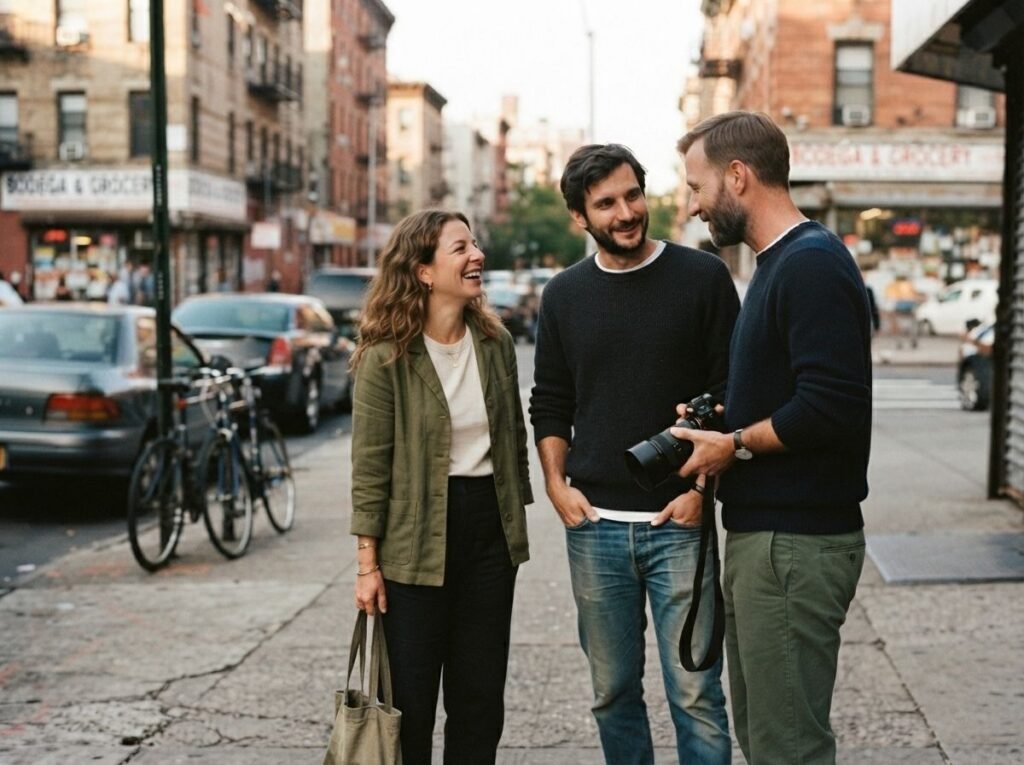
A good photographer is designing conditions, not manufacturing emotion
This may be the most important distinction in the entire process.
A photographer cannot manufacture intimacy on command.
They can, however, create circumstances in which intimacy has a chance to appear.
That requires more than knowing how to expose a photograph.
It requires reading people.
Canon recommends meeting with the couple before the session, discussing preferences and learning about their relationship and plans. This is practical preparation, but it also explains why photographer–couple chemistry matters so much.
A photographer who knows that one person hates being posed may work differently from one photographing a couple who enjoys theatrical direction.
Some couples need space.
Others need instruction.
Some become more comfortable when the photographer talks constantly. Others relax when the camera moves farther away.
There is no universal definition of “natural.”
Portraiture becomes more interesting when the photographer responds to the person rather than forcing every subject into the same formula. Adobe’s guide to portrait photography.
The photographer’s job is partly to discover what natural looks like for these particular people.
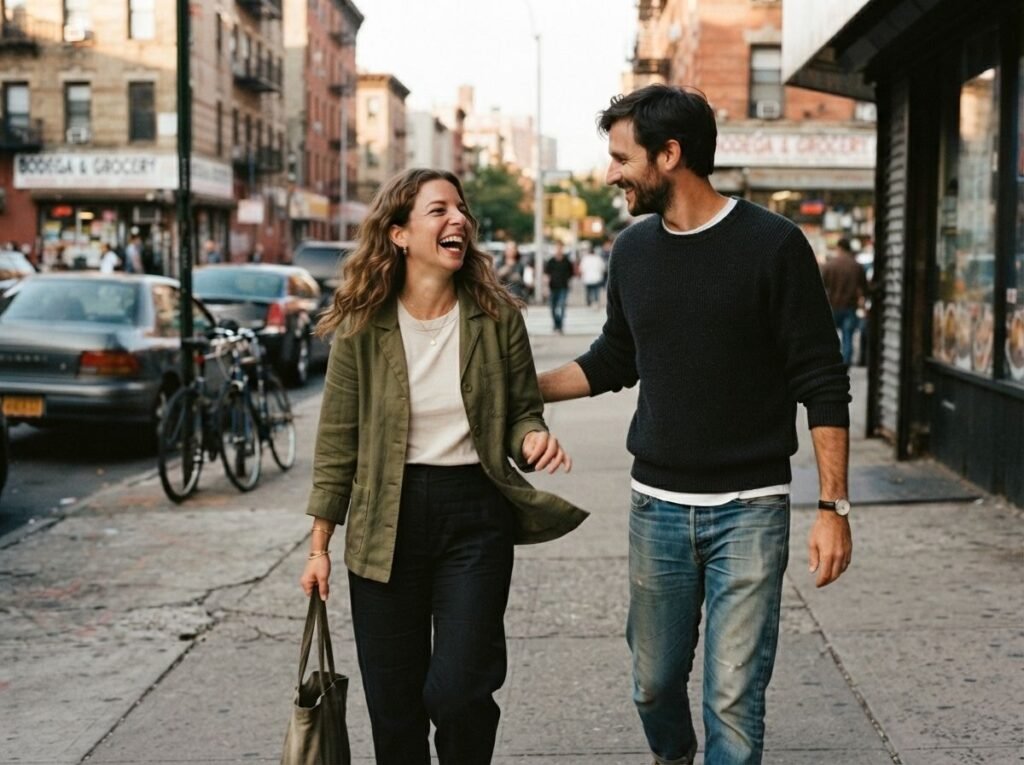
The photograph worth keeping may not be the most perfect one
There is a peculiar pressure around engagement photographs because they are often made for immediate public consumption: save-the-date cards, invitations, announcements and social media. Canon and Adobe both identify these as common uses for engagement photographs.
That encourages polish.
But photographs acquire a different value with time.
The perfectly posed image tells you what you looked like.
The slightly imperfect one might remind you what the afternoon felt like.
A gust of wind. A badly timed laugh. Someone looking away. A half-buttoned coat. A familiar street behind you. The photograph that initially seemed less impressive can become the one that carries the strongest memory because it contains information that a polished portrait has edited out.
This is where engagement photography becomes more than preparation for a wedding.
The wedding photographs will inevitably belong to the event: the clothes, the ceremony, the guests, the flowers, the architecture, the speeches.
The engagement photographs can belong to the period immediately before all of that.
They can preserve the ordinary world that existed around the decision to get married.
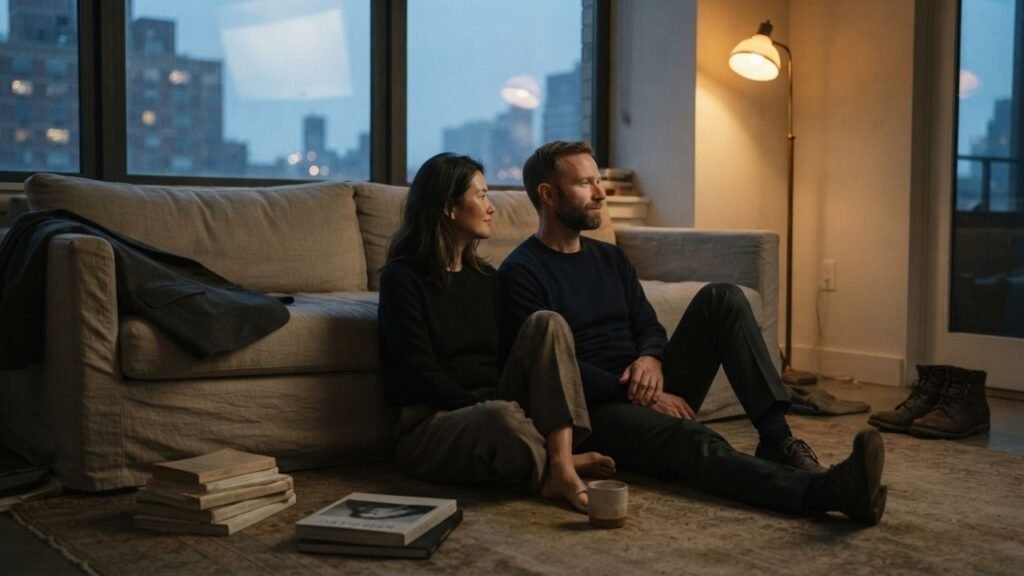
How to plan a session without turning it into a production
Start with the relationship, not the Pinterest board.
Choose one meaningful environment and one activity or movement rather than trying to collect every possible backdrop.
Then discuss the visual direction with the photographer.
Do you prefer photographs that feel documentary or composed? Close or environmental? Quiet or energetic? Colourful or restrained? Digital-clean or visibly textured?
These choices are more useful than sending fifty photographs labelled “inspiration.”
During the session, allow some warm-up time. Expect the first photographs to feel slightly awkward. That is normal. Canon recommends allowing an initial period for couples to become comfortable in front of the camera.
Then let the session loosen.
Move.
Talk.
Change locations if the first one stops giving you anything.
And leave some unscheduled time.
A photograph cannot record an unplanned moment if the entire afternoon has been planned out of existence.
What to take away
The strongest engagement photos don’t necessarily have the most dramatic scenery or the most elaborate styling.
They have specificity.
They contain something about the way these two people move, dress, joke, wait, touch, inhabit a room or occupy a particular place.
So before deciding what pose you want, decide what you want the photographs to remember.
Before choosing a location because it looks romantic, ask whether it tells us anything about your life.
Before asking a photographer to make everything candid, ask how they work with people who are nervous.
And before rejecting a photograph because it isn’t perfectly polished, look at it again.
Sometimes the detail that makes a photograph less perfect is the detail that makes it yours.