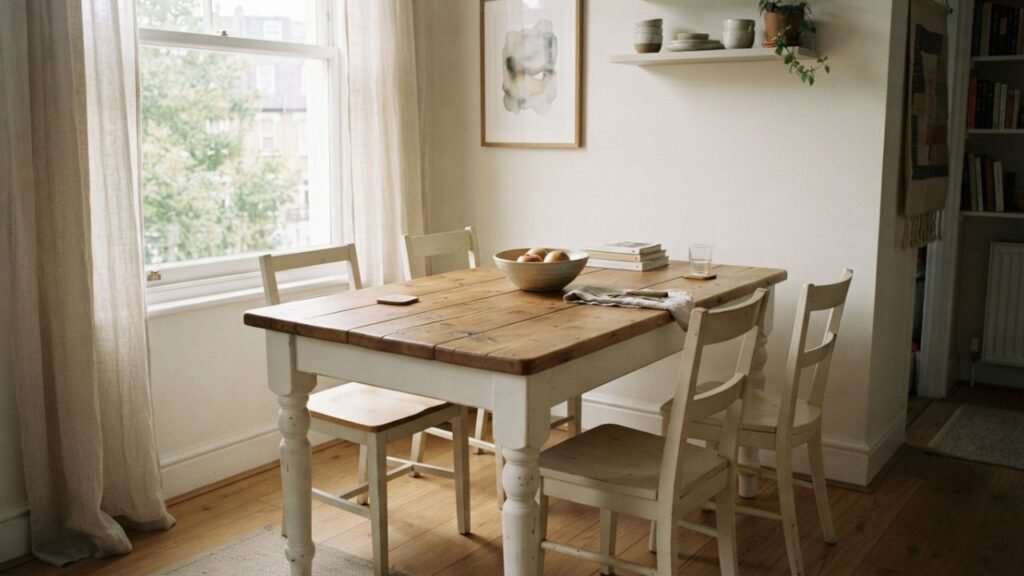
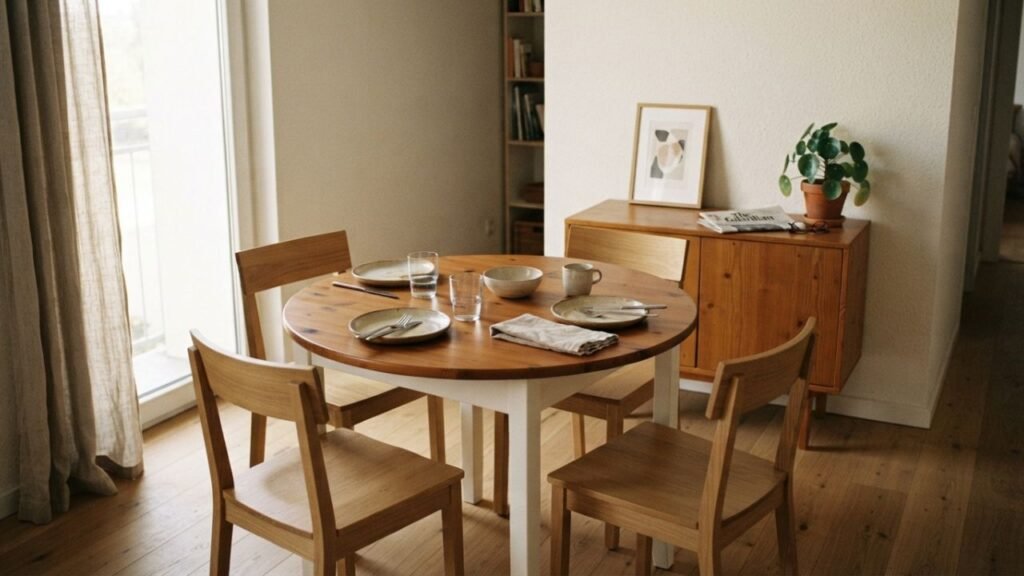
The Reagan is a compact pine table with a familiar farmhouse vocabulary. But its real appeal has less to do with style than with proportion, flexibility, and the realities of furnishing a smaller home.
A dining table can look perfectly reasonable online and become completely wrong the moment it enters a room.
That usually happens because photographs encourage us to think about furniture as an object. We notice the colour of the wood, the shape of the legs, the finish, perhaps whether it looks “farmhouse” or “modern.” What we don’t see as easily is the space the object occupies once chairs are pulled out, someone walks behind them, a serving bowl lands in the middle, and the table has to coexist with everything else.
The August Grove Reagan Pine Solid Wood Dining Table is worth examining for precisely this reason.
At 45 inches wide, 28 inches deep and 29 inches high, it is genuinely compact. Wayfair currently describes it as a four-person dining table made from solid pine, with a white base, brown top, four-leg construction and a 100-pound weight capacity. The listing currently shows a $179.99 price, although furniture pricing can change.
Those specifications make the Reagan less interesting as a decorative farmhouse table than as a case study in a much more useful question:
How small can a dining table be before it stops being a dining table and becomes merely a surface with chairs around it?
The answer depends less on the number of chairs than on how you live.

The 28-inch depth tells you more than the four-person capacity
“Seats four” is the specification most shoppers will notice first. It is also the least revealing.
The Reagan measures only 28 inches from front to back. That is enough for two people sitting opposite one another, but it leaves a relatively narrow central zone. Four people can use it comfortably for everyday meals, coffee or casual dining, which is exactly how the current product description positions it.
But imagine a different meal.
Four dinner plates. Four glasses. Cutlery. A bottle. A large salad bowl. Perhaps a serving dish that everyone needs to reach.
Suddenly, the difference between “four seats” and “four people eating comfortably” becomes obvious.
This is one of the most useful ways to evaluate a small dining table. Don’t ask only how many chairs fit. Ask what has to fit on the table while people are sitting at it.
For two people, the Reagan may feel generous. For four people eating a simple meal, it should be workable. For four people with a large family-style spread, it will feel much tighter.
That doesn’t make the table badly designed. It tells you what it was designed to do.
Its farmhouse look is quieter than the label suggests
The Reagan’s visual language is familiar: a warm brown pine top against a white base, visible grain and straightforward legs. Wayfair describes it as rustic and lodge-inspired, while also emphasizing its clean-lined silhouette.
The interesting part is the restraint.
There is no need for elaborate turned legs or heavy distressing to announce “farmhouse.” The contrast between the painted base and natural-looking wooden top does most of the work.
That gives the table a useful quality for someone furnishing a new home: it doesn’t dictate the rest of the room too aggressively.
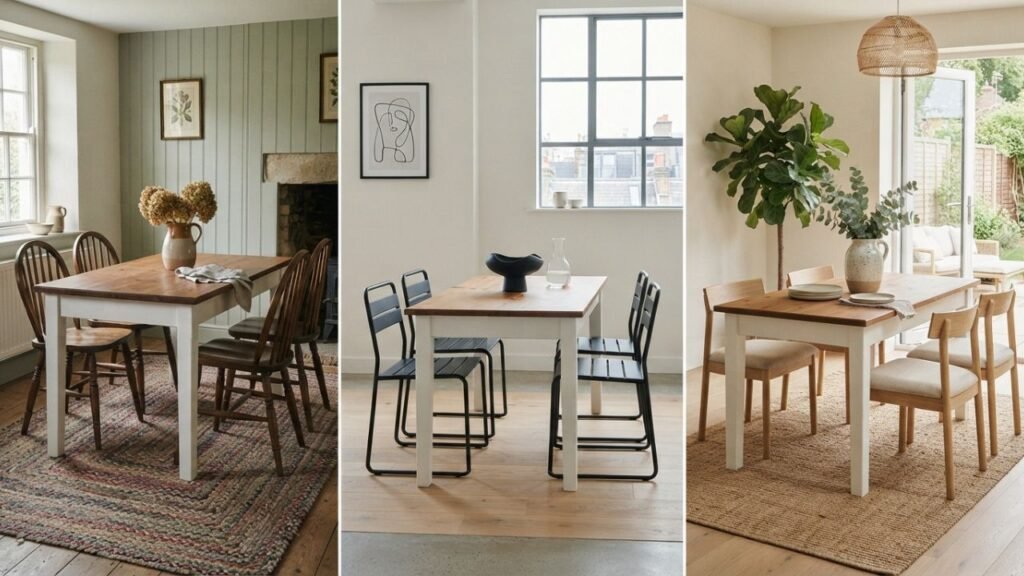
With Windsor-style or spindle-back chairs, it can lean traditional. With black chairs, it becomes more graphic. With simple natural-wood seating, the farmhouse reference becomes softer. Upholstered chairs can make the same table feel less kitchen-oriented and more like a dining-room piece.
This flexibility matters more than it might seem.
People often buy an entire dining-room aesthetic at once because a product photograph makes the furniture look complete. But a table is one of the pieces most likely to stay useful if it can survive changes in chairs, lighting, rugs and surrounding furniture.
The Reagan’s relatively simple silhouette gives it that opportunity.
“Solid pine” is good information, but it isn’t a quality guarantee
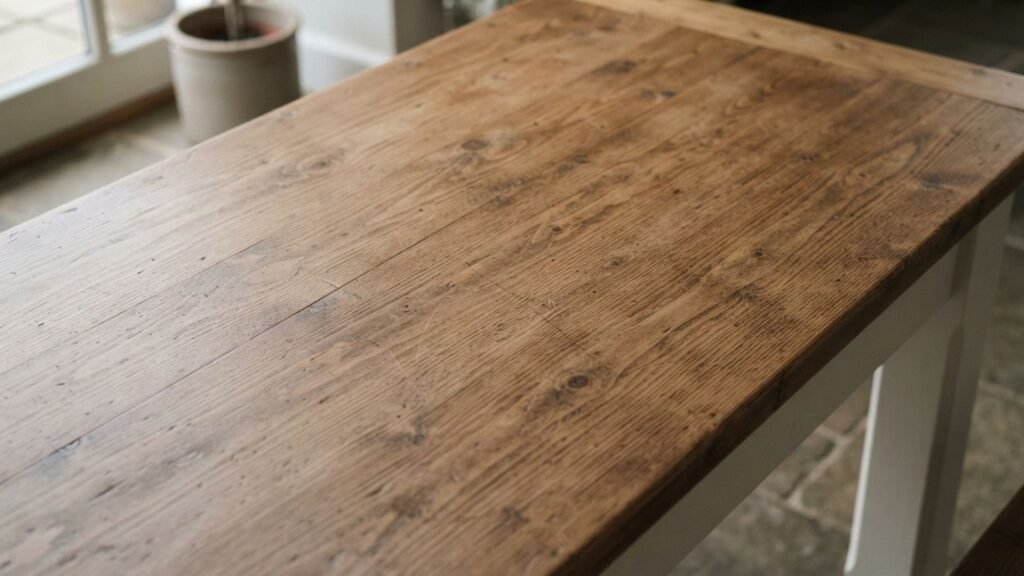
The table’s solid-pine construction is one of its more meaningful specifications. Both the top and base are listed as solid wood, with pine identified as the wood species.
But this is where furniture terminology deserves a little discipline.
Solid wood tells you what the material is. It does not automatically tell you how refined the joinery is, how carefully the surface has been finished, or whether the piece should be considered heirloom furniture.
Pine is also relatively soft compared with many hardwoods. For a useful explanation of how pine species differ in hardness, density and working properties, see The Wood Database’s guide to pine wood.
For a dining table, that can be either a problem or an advantage.
If you want a pristine surface that will look almost identical ten years from now, pine may require more patience. If you are comfortable with a table acquiring small marks, variations and signs of meals, work and everyday life, the material can feel appropriate rather than precious.
This is an important distinction when shopping online. “Solid wood” should make you investigate the material further, not end the investigation.

The table is surprisingly light—and that changes how it lives
The Reagan weighs 31.97 pounds according to the current specification.
That is useful information for anyone in a small apartment, rental or newly furnished home.
A table that can be moved relatively easily can be repositioned when the room changes. You can pull it away from the wall for dinner, move it aside when cleaning, or change the arrangement when guests arrive.
But there is another side to that lightness.
A heavy dining table visually anchors a room. A lighter table can feel more temporary. It may be easier to live with, but it won’t necessarily provide the architectural weight of a large oak or walnut dining table.
That distinction is worth considering before ordering.
If you want the dining table to become the visual centre of a large room, the Reagan may look underscaled. If you want the table to occupy as little territory as possible while still feeling like proper furniture, its lightness becomes part of the appeal.
Several customer-review patterns on Wayfair point in the same direction: buyers frequently praise the Reagan’s compact size, easy assembly and perceived sturdiness, while some mention minor surface imperfections. The overall current rating is 4.6 out of 5 from more than 1,100 reviews.
That doesn’t make every review equally reliable, but the consistency is useful: the table’s strongest reputation is not for exceptional craftsmanship. It is for being practical, attractive and easy to live with at its scale.
Don’t let the product description convince you the room is bigger than it is
There is a particularly useful lesson hidden in the Reagan’s product information.
Older or alternate versions of the Wayfair listing have contained conflicting language about the table’s seating and base, including references to a trestle base and six-person seating. The current detailed specifications identify it instead as a four-leg table with four-person capacity.
For a shopper, this is exactly why measurements should outrank marketing language.
Furniture listings can accumulate descriptive copy that is broader, older or less precise than the technical specification. A phrase such as “spacious seating” tells you very little. Forty-five inches by 28 inches tells you exactly what you are buying.
The same principle applies to almost every dining table.
When two descriptions disagree, trust the dimensions, construction details and photographs showing the actual product before trusting adjectives.
The best test costs nothing
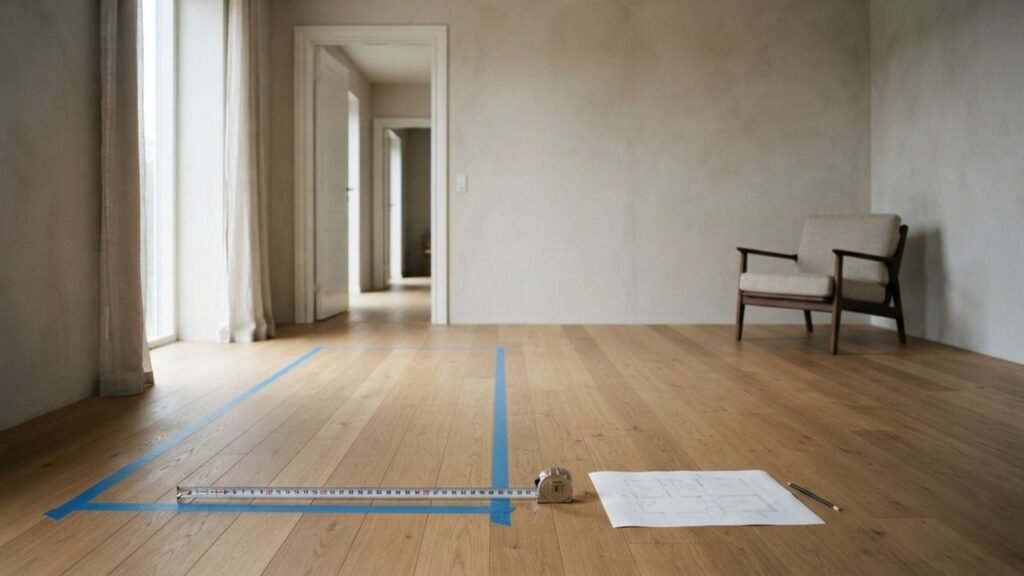
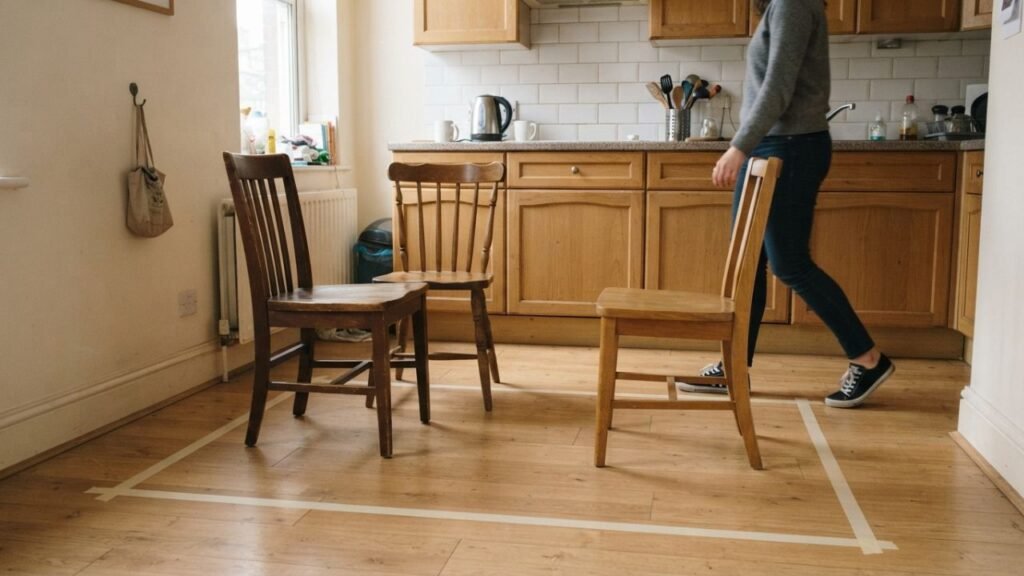
Before buying the Reagan, mark out a 45-by-28-inch rectangle on your floor.
Painter’s tape works. Cardboard works. Even newspapers can give you a rough sense of scale.
Then put four dining chairs around it.
Now do something more important: pull the chairs out as if someone were sitting down.
Walk behind them.
Open the nearby cabinet.
Stand where the kitchen doorway is.
Imagine someone carrying a hot dish from the kitchen.
This exercise reveals the thing product photography cannot: circulation.
A table can fit inside a room and still make the room feel cramped.
For a newly moved-in reader, this is particularly important because the temptation is often to buy the largest table that technically fits. Empty rooms encourage oversizing. Once a sofa, rug, sideboard, plants and lighting arrive, that extra 12 inches can become the difference between a room that functions and one that feels obstructed.
The Reagan is therefore best considered not as a small version of a large dining table, but as a table designed around the idea that dining does not always require a huge surface.

Who is the Reagan actually for?
The obvious answer is “people who like farmhouse furniture.”
The more useful answer is people who need four-person dining without surrendering too much floor space.
That could mean a small apartment, an eat-in kitchen, a compact dining room, a first home or a household of one or two people that occasionally hosts friends.
It is especially convincing if most meals are uncomplicated.
Breakfast. Coffee. Takeout. A laptop during the afternoon. Dinner for two. Four people sharing a meal without a collection of serving platters covering the tabletop.
For these situations, the Reagan’s compact dimensions are an asset rather than an apology.
The equation changes for frequent entertainers.
If your idea of dinner involves six people, multiple serving dishes and a bottle of wine between every two guests, this is probably the wrong table. No amount of farmhouse styling can overcome a surface that is physically too small.
Likewise, if you want a substantial piece that will visually anchor a formal dining room, look beyond this category.
The more interesting question is what you want the table to become
A dining table is rarely used only for dining anymore.
It can be a desk in the morning, a place to sort mail, a homework station, a surface for flowers, a temporary workbench, a place to wrap gifts, or the one spot where everyone in the household eventually leaves their things.
That makes proportion more complicated than simply calculating seating capacity.
The Reagan’s modest footprint gives it an advantage in this kind of mixed-use home. It can occupy a room without consuming the room.
And that may be the strongest argument for it.
There is a tendency in furniture shopping to treat size as an upgrade: bigger means more generous, more impressive, more capable. But a dining table is one of the rare objects where restraint can increase usefulness.
A table that leaves enough space for people to move around it may contribute more to daily life than a larger table that only performs well when fully occupied.
The August Grove Reagan is not an exceptional table because it solves every dining problem. It doesn’t.
It is interesting because it solves one very specific problem with unusual clarity: how to give a small room a proper dining table without making the dining table the whole room.
For someone furnishing a new home, that is a much more useful distinction than whether the table looks good in a catalogue photograph.
What to take away
The Reagan makes the most sense when space, flexibility and everyday use matter more than entertaining capacity.
- Dimensions: 45″ W × 28″ D × 29″ H.
- Material: solid pine wood for the top and base.
- Stated seating: four people.
- Weight: 31.97 lb.
- Weight capacity: 100 lb.
- Best fit: apartments, compact dining rooms, eat-in kitchens and households that mostly dine with two to four people.
- Main limitation: the 28-inch depth leaves limited room for large serving arrangements.
- Before buying: tape the actual dimensions onto your floor and test the room with four chairs pulled out.