What looks like a children’s party table is also a study in proportion, modular design, movement, and the way furniture quietly shapes an event.
A children’s table usually has a short visual life.
It appears at a birthday party, holds a few plates and paper cups, becomes part of a photograph, and disappears into storage. Most are designed around that narrow brief: small, practical, washable, inexpensive.
The VEGA YAN Kids Table takes a different approach.
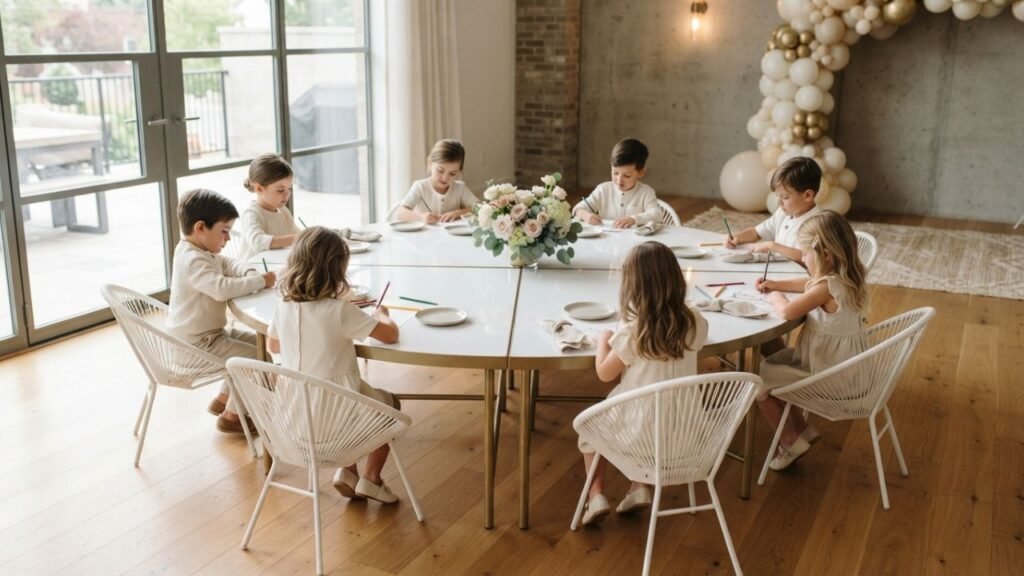
At first glance, its appeal is obvious. It is a low, circular table with a glossy white surface, metallic structure, and the polished presence of furniture intended for a carefully styled event rather than a classroom. But the more interesting detail is underneath the appearance: the table is not really one table.
It is four quarter sections that can be assembled into a full circle or rearranged into other configurations. The manufacturer describes each complete unit as four quarters, with a stated capacity of five children per quarter and up to 24 children when assembled as a full table. The full configuration is listed at roughly 8 feet in diameter, 23.6 inches wide and 20 inches high.
That changes how the object should be understood.
The VEGA YAN is less interesting as a children’s table than as a modular piece of event architecture.
The detail that matters is not the gold
There is an understandable temptation to read the VEGA YAN through its finish.
The white version combines a glossy acrylic top with an iron frame and stainless-steel legs. A gold version uses a gold-finished iron frame beneath the same glossy white surface.
That combination photographs easily. Against florals, balloons, sculptural cakes or a neutral venue, the table reads almost like a miniature banquet installation.
But the finish is not the most consequential design decision.
The four-piece construction is.
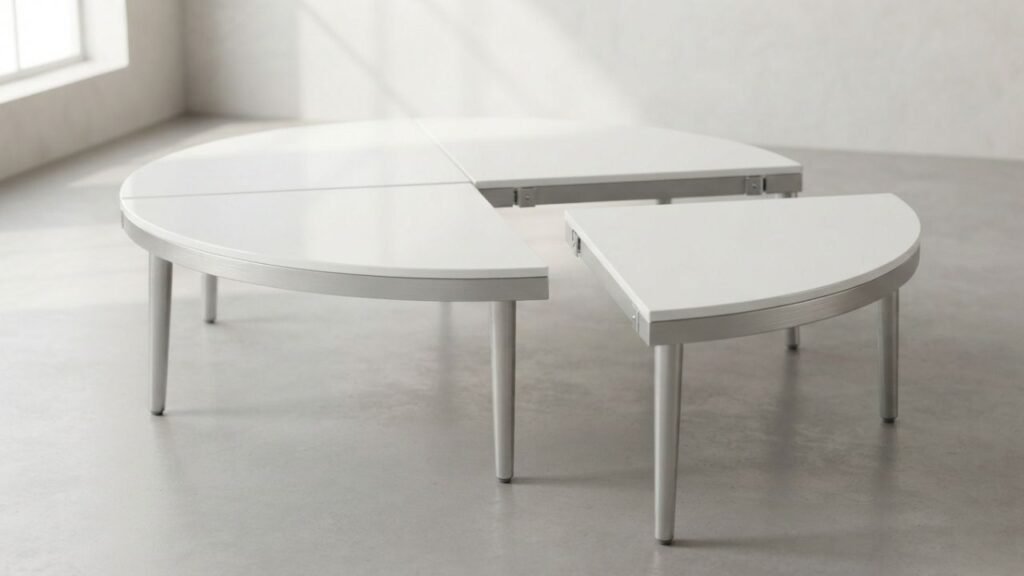
A conventional round children’s table has one spatial instruction: put it here. The VEGA YAN has several. A rental company can use the quarters as a complete circular dining area, or potentially deploy them as curved sections depending on the floor plan and event concept. The manufacturer specifically describes the sections as capable of being arranged in multiple shapes.
For event professionals, that distinction is substantial.
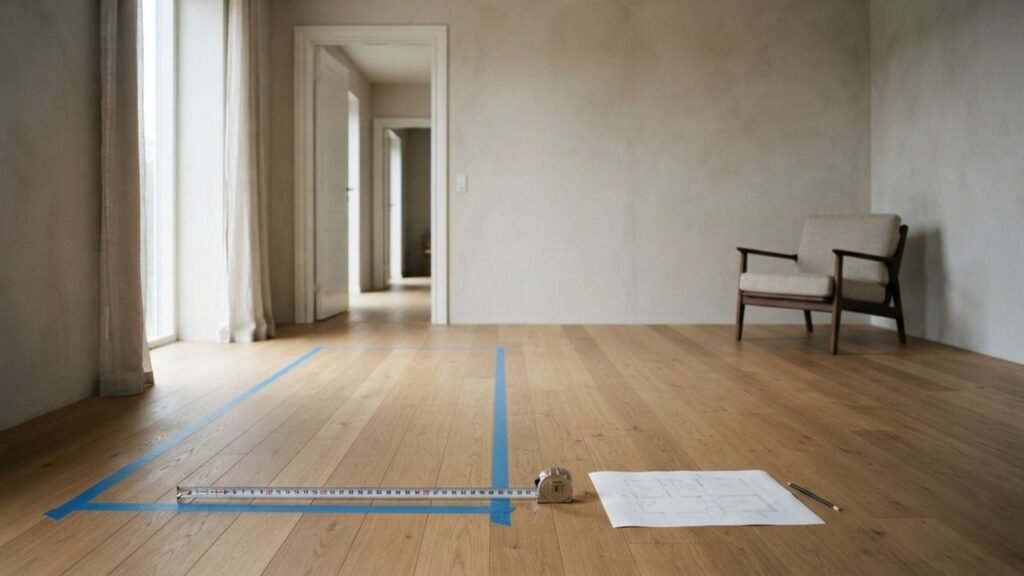
A birthday party rarely happens in a perfectly empty room. There may be a dessert installation occupying one wall, entertainment in another area, adult dining elsewhere, a photographer moving through the space, and a circulation route that needs to remain clear.
Furniture that can change its footprint is therefore solving a problem that has little to do with children’s furniture.
It is solving space.
Why a circular children’s table works differently
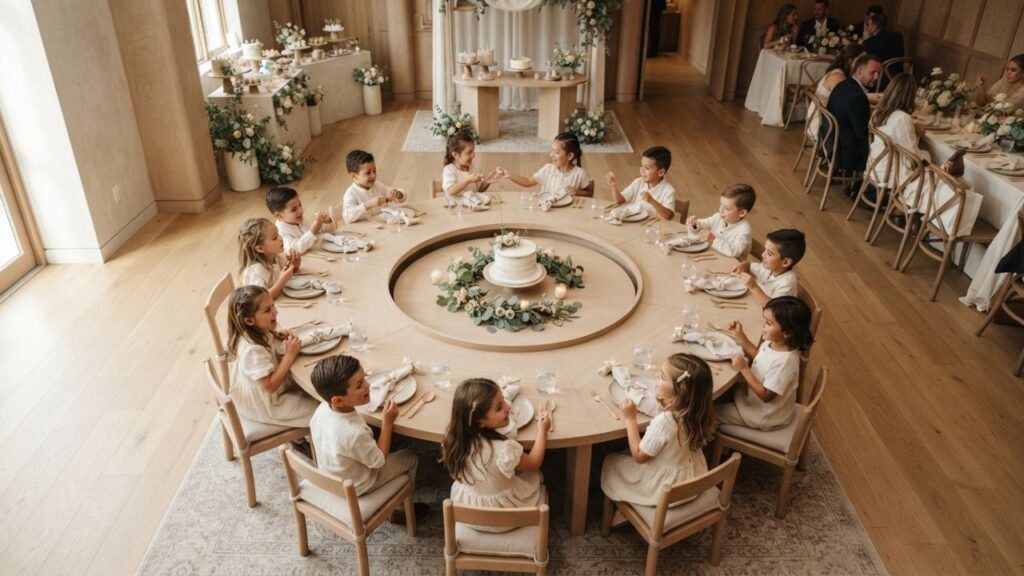
The circle also deserves more attention than it usually gets.
A rectangular children’s table establishes a front, a side and a sequence of seats. A circular arrangement creates a shared center. Children face one another rather than being distributed along a long axis.
For a styled party, that has a second effect: the table becomes a composition.
Place a cake, floral arrangement, craft activity or tableware installation at the center and the furniture begins organizing the surrounding scene. Photographers can work around it. Guests can see across it. Decorations don’t have to be pushed against one edge simply to keep the table usable.
This is one reason furniture designed for children increasingly appears in the visual vocabulary of high-end celebrations. The object has to perform two jobs simultaneously: support the child and support the image of the event.
The VEGA YAN is particularly suited to that second role because its surface and geometry are deliberately conspicuous rather than disguised.
That does not necessarily make it better furniture for every child. It makes it unusually appropriate to environments where the children’s area is part of the overall visual design.
The 20-inch height tells a different story
The published full-table height is 20 inches, or approximately 50 cm.
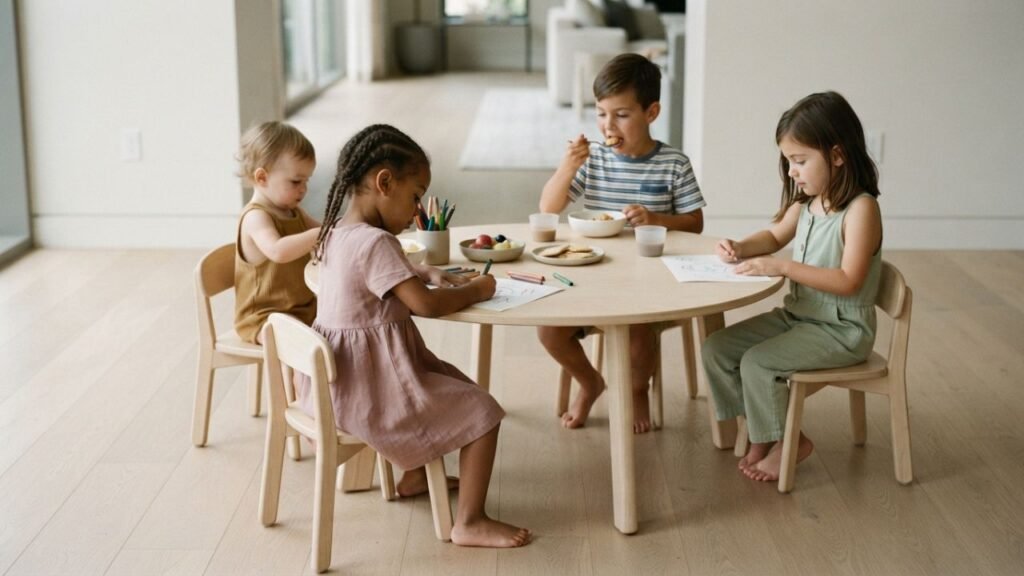
That number is more useful than the word “kids” on the product listing.
Children vary considerably in height, age and proportions. A table that works comfortably for a preschooler will not necessarily work equally well for an older child. So a responsible buyer should not treat the manufacturer’s capacity figure as a universal seating recommendation.
The stated capacity is also worth interpreting correctly.
“Up to 24 children” describes the manufacturer’s suggested occupancy for the complete configuration, not a guarantee that 24 children will have generous elbow room while eating, crafting or moving around.
For a banquet manager or rental company, the more useful question is therefore not simply:
How many children can fit?
It is:
How much usable space does each child need for the particular activity?
Six children eating a plated meal, five children decorating cookies and five children posing for photographs are three different spatial requirements.
That is an important distinction when planning an event.
For rental companies, modularity changes the economics
The VEGA YAN makes particular sense when considered as rental inventory.
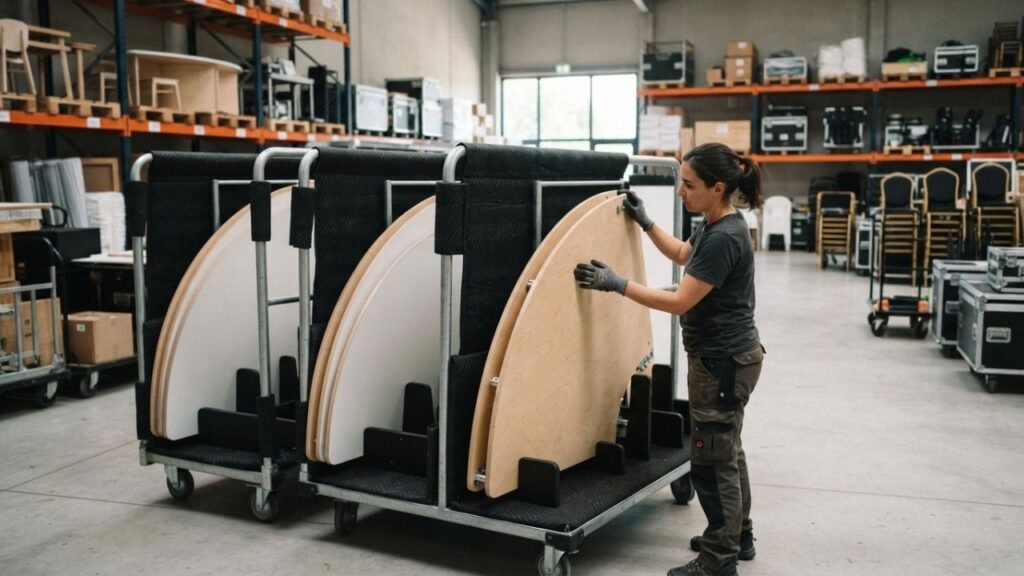
A conventional large children’s table occupies a fixed amount of storage space and serves a fairly fixed number of layouts. Four sectional pieces create a different inventory logic. The components can be stored and transported separately, then assembled at the venue by attaching the legs.
That does not automatically make the product easy to handle. A complete 8-foot-diameter installation is still a substantial object, and rental operators should consider vehicle capacity, protective wrapping, assembly time, loading weight and the possibility of damage to the glossy surface.
But modularity creates options.
A rental company can sell the same basic inventory into different event briefs:
- a complete circular children’s dining area
- a smaller curved installation
- multiple separated children’s zones
- a cake or activity table arrangement
- a visually prominent centerpiece for photographs
The commercial value, in other words, is not only in the table itself. It is in the number of room plans the table can participate in.
That is a much better way to evaluate expensive event furniture.
The glossy surface is both an advantage and a responsibility
Acrylic has an immediate visual advantage in this setting. The smooth, reflective surface gives the table a crisp appearance under event lighting and allows it to sit comfortably within contemporary party styling.
But glossy surfaces are unforgiving.
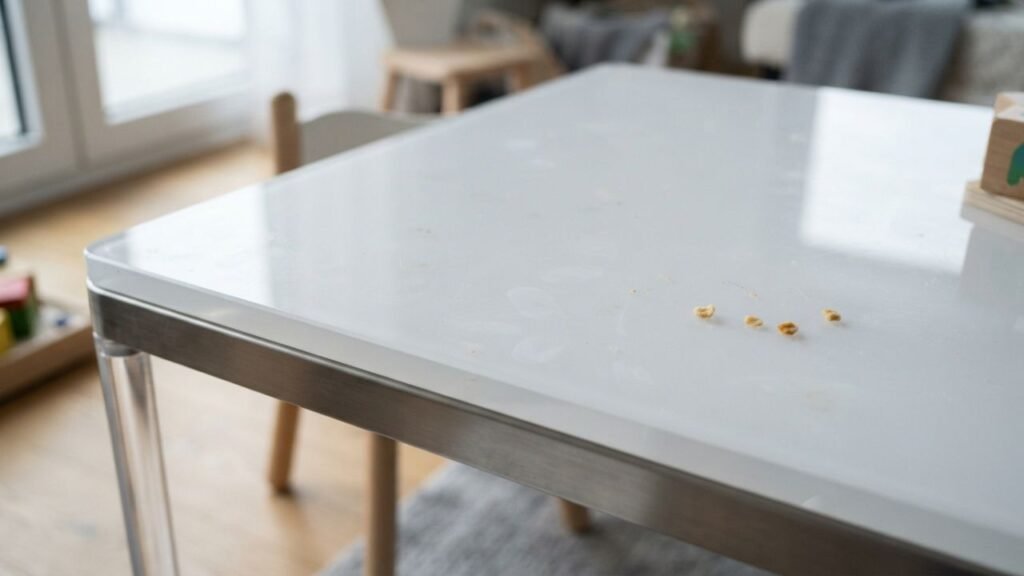
Fingerprints, food residue, scratches and small abrasions are more visible than they would be on a textured or matte children’s table. That matters enormously for rental inventory, where an object may move from one event to another with very little downtime.
The practical question before purchasing should therefore include the care regime:
What cleaning products does the supplier recommend? How easily can the surface be repaired or replaced? What happens when a quarter section is damaged? Are spare components available?
Those questions are not answered in the public product descriptions I found, so they are worth putting directly to the supplier before committing a substantial rental investment.
This is also where the distinction between event furniture and children’s furniture becomes important.
A beautiful table is not, by appearance alone, evidence of a particular safety certification.
I found published information about dimensions, materials, assembly and stated capacity, but I did not find independent safety certification or testing documentation for the VEGA YAN itself in the sources reviewed. That does not establish that the product is unsafe. It means buyers in regulated settings should request the relevant testing and compliance documentation from the supplier before purchase.
For daycares, early-learning environments and venues with formal safety requirements, that distinction matters.
U.S. requirements for certain children’s furniture, for example, address details such as stability, structural strength, sharp edges and pinch hazards. The CPSC’s guidance for children’s folding chairs and stools offers a useful illustration of how specific these considerations can be, although those requirements do not apply directly to the VEGA YAN table.
What photographers should notice
There is another reason the table is interesting: it changes the geometry of children’s photographs.
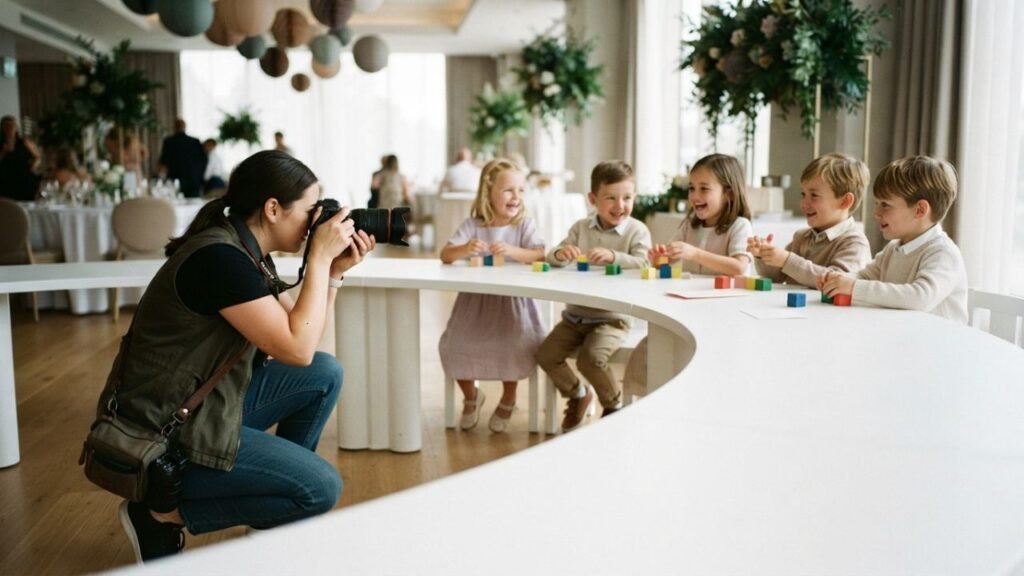
A long rectangular table naturally creates rows. A circular or serpentine arrangement produces curves, faces and bodies distributed through the frame.
That gives a photographer more visual options.
A child seated at the outer edge can be photographed against the sweeping line of the table. A group can be arranged around the curve rather than along a straight edge. From above, the circular configuration becomes a graphic element; from a lower angle, the table’s reflective surface can separate the children’s area from the surrounding décor.
The furniture therefore becomes part of the composition rather than simply a support object.
This is particularly useful in contemporary event photography, where the children’s table is often expected to appear intentional rather than merely functional.
What the VEGA YAN gets right
The strongest idea in the VEGA YAN is simple: children’s furniture does not have to disappear into the room.
The product treats the children’s area as part of the event’s architecture.
The low profile helps define the children’s area without visually closing it off, while the circular shape creates a more connected seating arrangement. Its sectional design then allows the table to adapt to different event layouts. And its polished materials allow it to coexist with the deliberately finished environments common to luxury children’s celebrations.
That does not mean it is the universal answer.
A daycare may have better reasons to choose a more durable commercial activity table, while a family looking for everyday furniture may find the VEGA YAN difficult to justify in terms of price and storage. For a rental company working with premium celebrations, the calculation changes. Here, the table’s value lies partly in its ability to become part of the event itself, contributing to the visual setting while adapting to different layouts.
That is the more revealing way to look at it.
The VEGA YAN is not really selling children a better place to sit.
It is giving adults a way to design the space around children with the same care they already give the adult tables, flowers, lighting and photographs.
And that may be why a piece of children’s furniture can command the attention of an entire event.
What to take away
If you’re evaluating a VEGA YAN Kids Table, look beyond the finish and ask five practical questions:
- Will the modular sections genuinely help your typical floor plans?
- Does the 20-inch height suit the actual age range of the children using it?
- Can your storage and transport operation handle four large sections?
- What cleaning, scratch-repair and replacement procedures does the supplier support?
- If children will use it in a regulated setting, what safety documentation can the supplier provide?
The most important specification may not be the 8-foot diameter or the glossy acrylic. It is the fact that the table can change the way a room is organized.
That is where the design becomes interesting.